Introduction
Losing everyday belongings around the house can turn a simple task into an unnecessary search. Keys may be left in a different room, a television remote can disappear between cushions, and a wallet or frequently used bag may be placed somewhere that is easy to forget. While smartphone-based tracking systems have become increasingly common, not every situation requires GPS, Bluetooth, an app, or an internet connection.
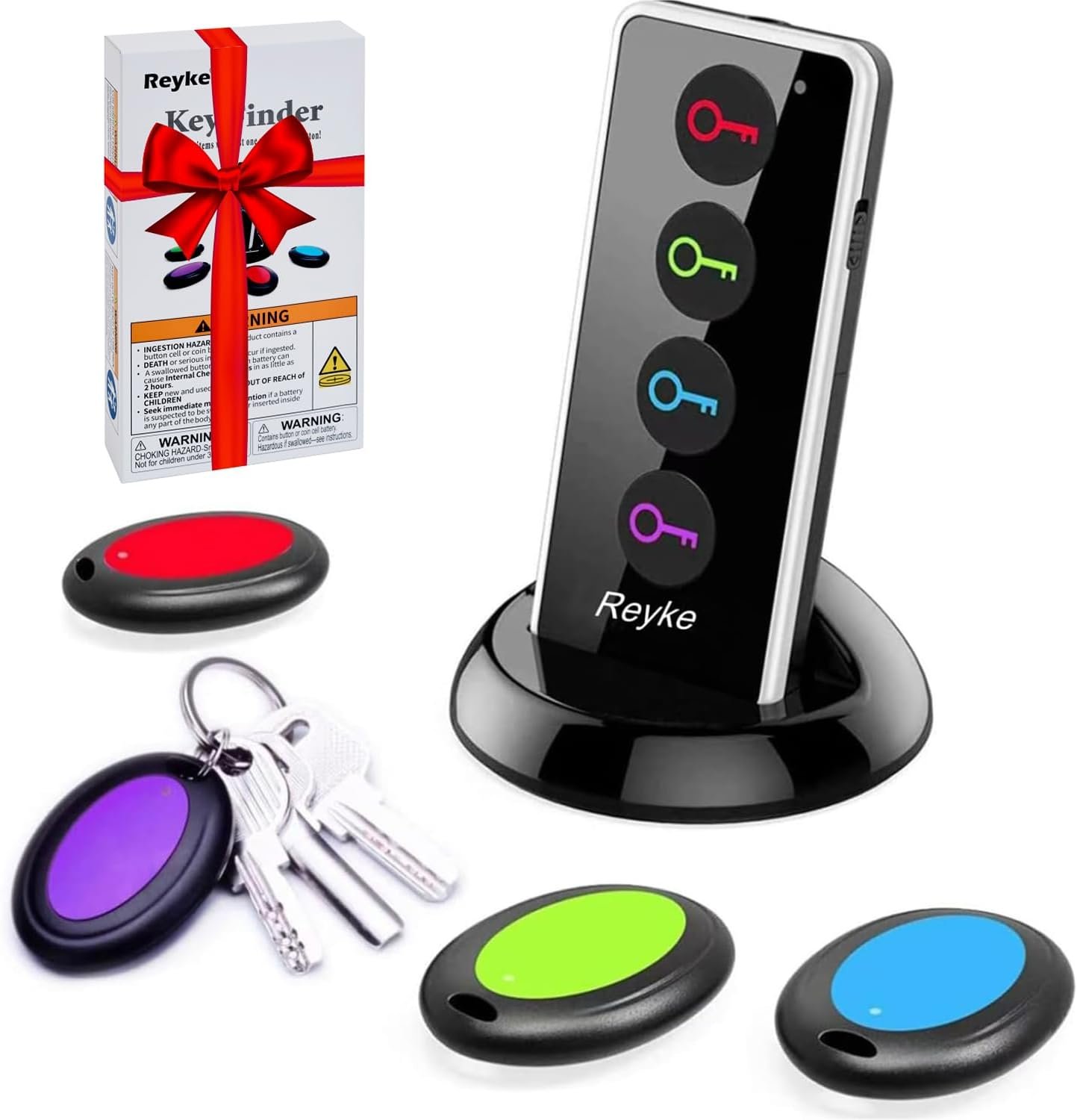
The Reyke Key Finder with Sound takes a more direct approach. It is a radio-frequency item-finding system built around a handheld remote and four receiver tags. Instead of showing an item’s position on a map, the system helps narrow down where a tagged object is by making the receiver produce an audible signal when the corresponding button on the remote is pressed. The product is advertised with a range of up to approximately 131 feet and includes four receivers.
This type of technology is particularly relevant for items that are normally misplaced somewhere nearby. A receiver can be attached to keys, a wallet, a remote control, a handbag, a backpack, or another frequently misplaced belonging. When the item goes missing, the user selects its corresponding button on the remote and follows the sound.
The basic concept is intentionally simple. There is no need to open a smartphone application or connect the system to a home Wi-Fi network. Instead, the dedicated remote communicates directly with the receivers through radio frequency.
That simplicity also defines the product’s limitations. A local RF key finder is not the same as a GPS tracker or a Bluetooth network tracker. It is designed to help locate an item within its communication range rather than provide its geographic position from a distant location.
The four-receiver configuration also makes it possible to create a small household locating system. One receiver can remain with house keys, another with a television remote, another with a frequently used bag, and the fourth with a wallet or another personal item.
This guide explores how the Reyke Key Finder works, its main features, practical applications, battery considerations, limitations, and the differences between RF key finders and other types of tracking technology.
Key Features of the Reyke Key Finder
Four Separate Receivers
The system is designed around four receiver units.
Each receiver can be assigned to a different item, allowing multiple belongings to remain tagged at the same time.
A household might organize them like this:
- Receiver 1: Car keys
- Receiver 2: House keys
- Receiver 3: Television remote
- Receiver 4: Wallet or handbag
This approach can be more convenient than having a single tracker that must be moved between objects.
The four-receiver arrangement also gives families some flexibility. Different people can use different receivers for their own frequently misplaced belongings.
Radio-Frequency Communication
The Reyke system uses radio-frequency communication between the handheld transmitter and the receiver tags.
This is an important distinction from Bluetooth-based trackers.
A dedicated RF finder does not need to establish a Bluetooth connection with a smartphone in order to activate the receiver. Instead, the transmitter is designed specifically for communicating with the included receiver units.
That means the basic locating process can be performed without:
- A smartphone app
- Wi-Fi
- Mobile data
- A GPS connection
- An online account
For users who prefer physical controls and a self-contained system, this can make the operating process relatively straightforward.
Advertised 131-Foot Range
The Reyke Key Finder is advertised with a range of up to approximately 131 feet.
However, range specifications should be interpreted carefully.
Maximum RF range is generally measured under favorable conditions. Indoor environments can produce different results because walls, floors, furniture, metal structures, and other obstacles can affect radio-frequency communication.
For example, a receiver located in the same room may respond more easily than one on another floor of a house, even if both locations fall within the theoretical maximum distance.
The 131-foot figure is therefore better understood as a stated maximum operating range rather than a guarantee that the receiver will respond at exactly that distance in every building.
Audible Finding Signal
The primary purpose of the receiver is to make an audible signal when activated.
Once the corresponding button is pressed, the receiver can help the user identify the location of the tagged object by sound.
This is particularly useful when an item is hidden from view.
For example, a television remote underneath a sofa cushion may not be visible, but an audible receiver can provide a clue about where to look.
Similarly, keys inside a coat pocket, bag, drawer, or another nearby location can be easier to locate when the receiver produces a sound.
The effectiveness of the sound naturally depends on the surrounding environment. Background noise, distance, walls, and objects covering the receiver can affect how easily the signal can be heard.
Visual Assistance
The receiver design also incorporates a visual locating function, with available product descriptions identifying a flashing light as part of the finding process.
A visual signal can provide a useful second clue once the user is close to the missing object.
This can be particularly helpful in darker areas or when the receiver’s sound is partially muffled.
The combination of sound and visual indication gives users two ways to identify the tagged item.
Dedicated Remote Control
The system uses a handheld transmitter with separate controls corresponding to the receivers.
This provides a straightforward operating method.
Instead of opening an application and selecting an item from a digital list, the user presses the appropriate physical button.
For households using all four receivers, establishing a consistent button system can make the device easier to use.
For example:
Button 1: Car keys
Button 2: TV remote
Button 3: Backpack
Button 4: Wallet
Once these assignments become familiar, the user can activate the appropriate receiver without needing to remember which physical tag belongs to which item.
Key-Ring Attachment
Key finders are naturally suited to keys, and a receiver can be attached to a key ring or another suitable attachment point.
This makes it possible for the receiver to remain with the keys during normal daily use.
Permanent attachment is generally more practical than removing the receiver after every search because the purpose of the system is to be available when an item is unexpectedly misplaced.
Adhesive Attachment Options
For objects without a convenient loop or key ring, an adhesive attachment method can be useful.
This is particularly relevant for remote controls.
A television remote normally does not have a built-in ring where a tracker can be attached. A small receiver can instead be secured to an appropriate flat surface.
Before using adhesive, the surface should be clean and dry, and users should consider whether removing the adhesive could affect the finish.
Compact Receiver Format
Small receivers can be easier to attach to everyday belongings without adding substantial bulk.
This matters for objects such as:
- Keys
- Wallets
- Remote controls
- Small bags
- Pouches
- Glasses cases
A bulky tracker can interfere with normal use, while a smaller receiver can remain attached more discreetly.
How the Reyke Key Finder Can Be Used
Finding Car Keys
Car keys are among the most obvious applications for an item finder.
A receiver can remain attached to the key ring.
If the keys are misplaced inside the home, the user can press the corresponding remote button and listen for the receiver.
The sound can help narrow the search to a particular area, such as a bedroom, hallway, kitchen, or living room.
Once the user is close, the visual signal can provide an additional clue.
Locating a Television Remote
Television remotes are frequently moved from their usual location.
An adhesive-mounted receiver can remain attached to the rear of a suitable remote.
If the remote disappears under a sofa cushion or behind another object, the receiver can be activated.
This application demonstrates one of the practical differences between an RF key finder and a traditional key organizer: the system is intended to help locate an item after it has already been misplaced.
Finding a Wallet
A wallet can be another useful candidate for a receiver.
Depending on the wallet design, the receiver can be placed inside or attached to an appropriate surface.
When a wallet disappears somewhere around the home, the user can activate the corresponding receiver and follow the sound.
Care should be taken to ensure that the receiver does not interfere with the wallet’s normal operation or damage its material.
Locating a Handbag
A handbag or purse can be fitted with a receiver using a key ring or another suitable attachment method.
This can be useful when the bag is left in another room, placed inside a closet, or stored somewhere that is difficult to remember.
For travel, the same concept can be applied to a small personal bag.
Finding a Backpack
Students, commuters, and other users who regularly move bags between locations can attach a receiver to a backpack.
The finder can be useful inside a home or other local environment where the transmitter remains within range.
It should not be interpreted as a long-distance tracking device if the backpack is taken outside the RF operating area.
Locating a Glasses Case
Eyeglasses themselves are generally not ideal attachment targets because an accessory can interfere with handling.
A glasses case may provide a more practical attachment point.
The receiver can remain with the case so that the user can locate both the case and glasses together.
Finding Frequently Misplaced Household Items
The fourth receiver can be reserved for another item that tends to disappear.
Possibilities include:
- Game controllers
- Camera bags
- Small tool cases
- Frequently used pouches
- Luggage
- Electronic accessories
- Office bags
The goal is not to track everything a household owns. Instead, the system can be focused on a small number of items that are repeatedly misplaced.
Creating an Efficient Finding Routine
Assign Each Receiver a Permanent Purpose
One simple strategy is to avoid constantly changing receiver assignments.
For example:
Receiver 1 always stays with the car keys.
Receiver 2 always stays with the television remote.
Receiver 3 always stays with the backpack.
Receiver 4 stays with the wallet.
This creates a predictable system.
Keep the Transmitter in One Place
The remote itself should have a designated storage location.
An entryway table, desk drawer, bedside table, or another consistent location can work.
This is an important part of the system because the transmitter is the tool needed to activate the receivers.
A finder becomes less useful if the transmitter is itself frequently misplaced.
Test Each Receiver Periodically
A simple test can confirm that the system remains operational.
Every few weeks or months, users can activate each receiver and verify that:
- The transmitter responds correctly.
- The receiver produces its alert.
- The visual signal works.
- The receiver remains securely attached.
- Batteries are still functioning.
Periodic testing can identify problems before the finder is urgently needed.
Who the Reyke Key Finder May Be Suitable For
Busy Families
Families often have several objects that are moved between rooms throughout the day.
A four-receiver system can provide a simple way to tag several frequently misplaced belongings.
The physical remote also means that family members do not necessarily need to share a smartphone account or application.
People Who Prefer Simple Devices
Some users prefer dedicated electronics with a small number of physical controls.
The Reyke system is designed around a transmitter and receiver relationship rather than a smartphone application.
That can make it suitable for people who want a straightforward locating process.
Older Adults
A physical button-based system may be easier for some people who do not regularly use smartphone applications.
The locating process can be reduced to a simple sequence:
- Pick up the remote.
- Press the corresponding button.
- Listen for the receiver.
- Follow the signal.
However, hearing ability varies, so users who have difficulty hearing audible alerts may need to consider whether this type of finder is appropriate for their needs.
People Who Frequently Misplace Keys
For someone who regularly searches for keys inside the home, a receiver permanently attached to the key ring can provide a convenient backup.
It does not prevent keys from being misplaced, but it can reduce the amount of time spent searching for them when they are nearby.
People Who Do Not Want an App
An RF key finder can be an alternative for people who do not want to install another smartphone application.
This may also be relevant in households where different family members use different types of smartphones.
Important Things to Consider
It Is Not a GPS Tracker
The most important distinction is that the Reyke Key Finder is a local RF locator.
It does not provide GPS coordinates or show the tagged object’s location on a map.
If the keys are left in another city, the RF remote cannot provide their location from home.
The system is designed for nearby finding.
The 131-Foot Range Is a Maximum Specification
The advertised 131-foot range should not be interpreted as an indoor guarantee.
RF performance can change considerably depending on the environment.
Factors that may affect the effective range include:
- Concrete walls
- Multiple floors
- Metal structures
- Furniture
- Electrical interference
- Receiver orientation
- Transmitter orientation
- Building layout
A receiver that works reliably across an open area may respond at a shorter distance inside a building.
Sound Can Be Blocked
If the receiver is buried beneath clothing, inside a drawer, under cushions, or inside a closed bag, its alert may be muffled.
This is not necessarily a problem with the finder itself; it is simply a characteristic of audible locating systems.
The closer the user gets to the receiver, the easier it may become to identify the signal.
The Device Does Not Prevent Theft
A key finder helps locate misplaced belongings.
It does not prevent someone from taking an item, and it does not provide a security alarm or remote theft notification.
For valuable equipment or objects that may leave the local area, a different tracking technology may be more appropriate.
Attachment Quality Matters
A receiver can only help locate an item if it remains attached to that item.
For key rings, users should periodically check the ring and receiver connection.
For adhesive attachments, inspect the adhesive periodically, particularly if the item is handled frequently.
Heat, dust, moisture, and repeated friction can affect adhesive performance.
Consider the Object’s Surface
Adhesive attachment is not equally suitable for every material.
Smooth, clean surfaces may provide better adhesion than fabric, rough plastic, dusty surfaces, or textured finishes.
If the object is valuable or delicate, users should consider whether an adhesive attachment could leave residue or affect its appearance.
Battery Maintenance Is Important
The transmitter and receivers depend on batteries.
Like any battery-powered device, performance can decline as batteries approach the end of their service life.
If the finder has not been used for an extended period, testing it before relying on it is sensible.
Keep Small Components Away From Young Children
Receiver units and batteries can present hazards to young children.
They should be stored and used in accordance with the manufacturer’s safety instructions.
Button-cell and other small batteries can be particularly dangerous if swallowed, so battery compartments should remain properly secured and inaccessible to young children.
Comparison With General Tracking Categories
RF Key Finder vs. Bluetooth Tracker
Bluetooth trackers generally communicate with a smartphone and can offer app-based functions.
Some can show a last-known location or participate in larger device networks.
An RF key finder takes a simpler approach.
The transmitter directly activates a receiver, which responds with a sound and possibly a light.
The two systems therefore solve somewhat different problems.
An RF finder is oriented toward local, direct finding.
A Bluetooth tracker can provide more digital location features depending on its ecosystem.
RF Key Finder vs. GPS Tracker
GPS trackers are designed for situations where location information over larger distances matters.
They can be useful for vehicles, equipment, and other assets where remote monitoring is important.
A four-receiver RF key finder is not designed for this purpose.
Its primary role is helping a person locate an object somewhere nearby.
RF Key Finder vs. Smartphone Location Services
Smartphones can use built-in location services to help users find compatible devices.
That approach depends on the phone ecosystem and the compatibility of the item being tracked.
The Reyke system instead uses a dedicated physical transmitter.
This means that users do not need to depend on a phone application for basic operation.
RF Key Finder vs. Traditional Key Storage
A designated key hook, tray, or drawer can reduce the likelihood of losing keys.
However, these organizational systems rely on the user putting the item back in the correct location.
A finder addresses the situation after the item has already been misplaced.
Using both strategies can be practical: store keys in a consistent place while keeping the receiver attached as a backup.
Practical Ways to Use the Four Receivers
Entryway Organization
An entryway is a natural location for the transmitter.
Receivers can remain attached to the items most frequently needed when leaving the house.
For example:
- Car keys
- House keys
- Work bag
- Wallet
This arrangement connects the finder with a predictable daily routine.
Living Room Organization
A household could reserve one receiver for the television remote.
Another could be used for a game controller.
The transmitter can stay on a nearby shelf.
This makes it possible to find frequently moved entertainment accessories without searching the entire room.
Home Office
The system can also be used for office-related items.
A receiver could remain attached to a laptop bag, presentation pouch, or equipment case.
This is particularly useful for people who regularly move between a home office and other parts of the house.
Travel
A receiver can remain attached to luggage or a smaller travel bag.
When traveling, however, users should understand that the system is still limited by RF range.
It can help locate a bag in a hotel room or nearby environment, but it is not a replacement for a long-distance luggage tracker.
Making the Most of an RF Item Finder
Start With the Most Frequently Lost Items
There is no need to tag every object.
A better approach is to identify the four belongings that cause the most searching.
This might include:
- Car keys
- Television remote
- Wallet
- Backpack
Once those objects are covered, the fourth receiver can be reassigned if another item becomes more problematic.
Use Consistent Names
A household can make the system easier to remember by using simple names.
Instead of “receiver three,” think:
“Three is the backpack.”
Simple associations reduce confusion.
Combine Sound With Visual Searching
When the receiver activates, listen first.
As you move closer, look for the flashing signal if the model provides one.
This combination can help narrow down the location more efficiently than relying exclusively on either sound or sight.
Use the Finder Before the Search Becomes Frustrating
The purpose of a key finder is to reduce unnecessary searching.
If an item is known to have been misplaced nearby, activating the appropriate receiver early may be more efficient than checking every room manually.
Battery and Maintenance Considerations
Check the Transmitter
Because the transmitter controls all four receivers, its battery condition matters for the entire system.
If none of the receivers responds, checking the transmitter batteries is a logical first step.
Check Individual Receivers
If three receivers work but one does not, the issue may be specific to that receiver.
Possible things to check include:
- Battery condition
- Battery installation
- Attachment damage
- Receiver position
- Range
- Physical damage
Inspect Attachment Points
A receiver that becomes loose can be lost along with the object it was supposed to help locate.
Key-ring connections should be inspected periodically.
Adhesive-mounted receivers should also be checked for lifting edges or weakened adhesion.
Store the System Carefully
The transmitter should be stored somewhere dry and easy to remember.
Receivers should remain attached to their assigned objects whenever practical.
If the system is stored for a long period, battery-storage recommendations from the manufacturer should be followed.
Frequently Asked Questions
What is the Reyke Key Finder?
The Reyke Key Finder is a radio-frequency item-locating system designed around a handheld transmitter and four receiver units. It is intended to help users find nearby belongings by triggering an audible alert from the appropriate receiver.
How many receivers are included?
The system includes four receivers.
Each can be assigned to a different item.
What is the advertised range?
The product is advertised with a range of up to approximately 131 feet. Actual range can vary depending on environmental conditions.
Does it use GPS?
No. The system uses radio-frequency communication rather than GPS.
Does it require Wi-Fi?
The RF locating process does not depend on a Wi-Fi network.
Does it require a smartphone?
No. The dedicated transmitter is designed to operate with the included receiver units without requiring a smartphone application.
Can it find car keys?
Yes. A receiver can be attached to a key ring, allowing the user to activate the receiver when the keys are misplaced within the system’s usable range.
Can it find a television remote?
Yes. A receiver can be attached to a compatible remote using an appropriate attachment method.
Can it be used with a wallet?
A receiver can be attached to or placed with a wallet, provided the attachment does not interfere with the wallet’s normal use.
Does the receiver make a sound?
The receiver is designed to provide an audible signal when activated by the transmitter.
Does it have a light?
Available product descriptions identify a flashing light as part of the receiver’s locating function.
Can the finder work through walls?
RF signals can pass through some obstacles, but walls, floors, metal, and other structures can reduce effective range. Indoor performance can therefore differ from open-area specifications.
Is the 131-foot range guaranteed indoors?
No. Maximum range specifications should not be interpreted as guaranteed indoor performance.
Can the finder locate something in another city?
No. This is a local RF finder, not a GPS or cellular tracking system.
Can it prevent theft?
No. The system helps locate misplaced items but does not function as an anti-theft system.
What happens if the receiver is under a sofa cushion?
The sound may still help identify the general area, although the cushion can muffle the signal. Moving closer to the receiver can make the alert easier to hear.
Can the receivers be attached to bags?
Yes. A suitable receiver can be attached to a backpack, handbag, luggage, or another bag using an appropriate attachment method.
Can the receiver be attached with adhesive?
An adhesive attachment method can be used for suitable smooth surfaces. Users should consider the material and finish of the object before applying adhesive.
Can the receivers remain attached permanently?
They can be left attached to frequently misplaced items when the attachment method is secure and appropriate.
How many objects can be tracked at the same time?
The four-receiver configuration allows four objects to be tagged simultaneously.
Can multiple family members use the system?
Yes. Different receivers can be assigned to belongings used by different household members.
Is an RF finder the same as a Bluetooth tracker?
No. RF finders use a dedicated transmitter and receiver system, while Bluetooth trackers generally connect with smartphones and associated applications.
Is an RF finder the same as a GPS tracker?
No. GPS trackers are designed to provide geographic location information over much greater distances. An RF finder is intended primarily for nearby locating.
What is the main advantage of a dedicated transmitter?
A dedicated transmitter provides physical controls that can activate the receiver without requiring a smartphone, application, or internet connection.
What should be checked if a receiver does not respond?
Check the receiver battery, transmitter battery, distance, obstacles, and physical condition of the receiver. Also verify that the correct transmitter button is being used.
How can the system be made easier to use?
Assign each receiver a permanent purpose, keep the transmitter in a consistent location, and periodically test all four receivers.
Conclusion
The Reyke Key Finder with Sound and 131-foot RF range is designed around a straightforward idea: attach small receiver tags to frequently misplaced belongings and use a dedicated remote to make the appropriate receiver respond when an item goes missing.
Its four-receiver configuration allows several objects to remain tagged simultaneously. Car keys, house keys, remote controls, wallets, bags, glasses cases, and other everyday belongings can all be candidates for this type of local finding system, provided the receiver can be attached securely and appropriately.
The advertised range of up to approximately 131 feet provides a useful reference point, but real-world RF performance depends on the surrounding environment. Walls, floors, furniture, metal structures, interference, and other obstacles can reduce the effective distance. The same principle applies to the audible signal: a receiver in an open room may be easier to hear than one buried under cushions or inside a closed drawer.
It is also important to understand what the system does not do. The Reyke Key Finder is not a GPS tracker, does not provide a map, and is not intended to locate belongings from another city or across the internet. Its role is much more specific: helping users find nearby objects that have been misplaced.
For households that frequently spend time searching for keys, remotes, wallets, bags, or other everyday items, an RF finder can become a simple part of an organization routine. Assigning each receiver to a specific item, keeping the transmitter in a known location, and periodically checking batteries can make the system easier to rely on.
Compared with smartphone-based tracking technologies, the RF approach emphasizes simplicity and direct physical control. Compared with traditional storage solutions, it provides assistance after an item has already been misplaced. Understanding those differences makes it easier to determine whether this type of item finder fits a particular household’s needs.
You can check more details on Amazon here.
As an Amazon Associate, we earn from qualifying purchases.
Leave a Reply